| 1940 |
Roots of company are formed as several executives
of the Curtiss-Wright Aircraft Corporation begin
discussions as to feasibility of a separate
first-of-its-kind aircraft research facility
|
| 1942 |
Curtiss-Wright agrees to finance construction
of research laboratory and an 8 x 12-foot subsonic
wind tunnel, one of the nation's largest,
in Buffalo, N.Y. First concrete for building
is poured on June 22
|
| 1943 |
New Research Laboratory of the Curtiss-Wright
Airplane Division at Buffalo is dedicated and
Dr. Clifford C. Furnas is appointed its first
Director
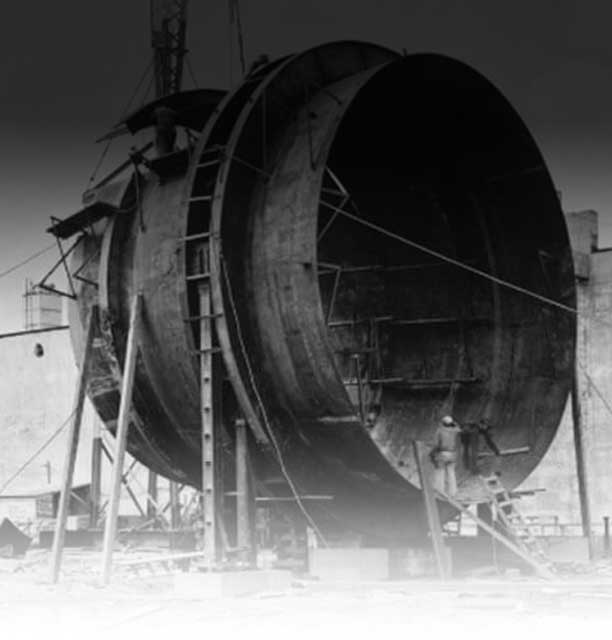
Work begins on the largest, most expensive piece
of equipment in the building - the wind
tunnel
($3.5 million). When completed, the tunnel will
be capable of testing large airplane models
up to the then-unheard of speed of 750 miles
per hour - approximately the speed of
sound.
|
| 1945 |
During war years, Laboratory grows steadily
as part of the flourishing Curtiss-Wright family.
But 1945 V-J Day documents barely signed when
company is deluged with telegrams canceling
contracts for wartime production of aircraft.
Within weeks, production is reduced to 5 percent
of war-time peak.
After a series of hastily called meetings, Curtiss-Wright
decides to abolish the Airplane Division in
Buffalo and discontinue underwriting the activities
of the Research Laboratory
Dr. Furnas expresses intent to keep the Laboratory
operating and enters into serious discussions
with Cornell University. On Dec. 21, Curtiss-Wright
bequeaths the Laboratory to Cornell
and provides a cash gift to complete unfinished
wind tunnel.
|
| 1946 |
On January 2, with Dr. Furnas as director,
the 545 employees of Curtiss-Wright Research
Laboratory become employees of Cornell Aeronautical
Laboratory (CAL). Fundamentally,
their resources consist of $675,000 contributed
by six Eastern U.S. aircraft manufacturers for
working capital and enough government research
contracts to keep the new organization in
business for a few months.
|
| 1947 |
CAL wind tunnel becomes operational and research
begins in automotive safety
|
| 1948 |
Laboratory is incorporated as Cornell Aeronautical
Laboratory, Inc., a wholly owned subsidiary
of Cornell University, and the Treasury Department
rules the corporation to be exempt from
federal income tax, thus establishing "non-profit"
status that continues until 1972
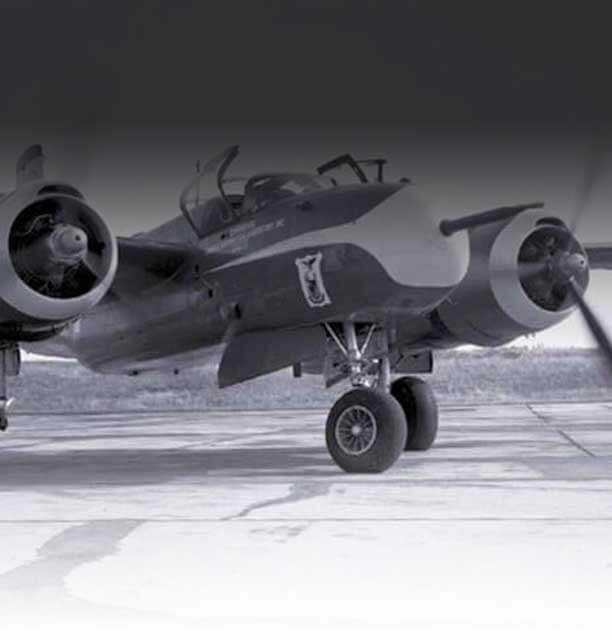
Designs and tests Navy F-4U-K fighter, the first
in-flight variable stability aircraft developed
by
the company over the years for researching the
handling qualities of aircraft
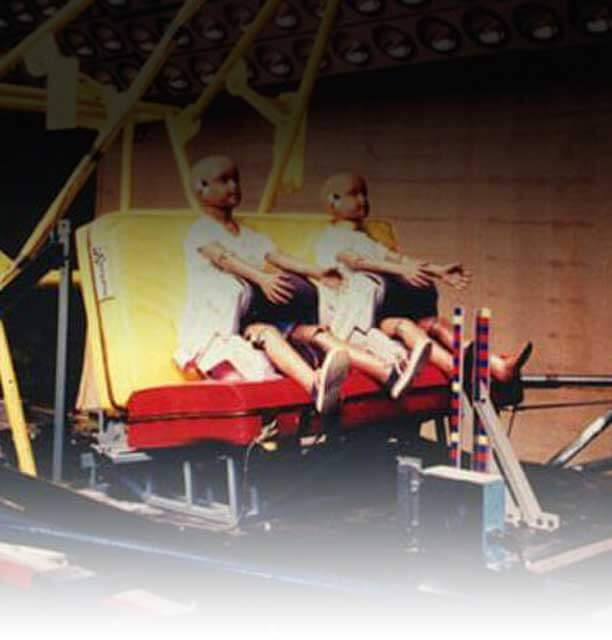
Develops the primitive "Thin Man"
crash test dummy to evaluate the impact of simulated
car
crashes on the human body and for studies of
pilot safety in Naval aircraft
|
| 1951 |
Develops prototype version of a hypersonic
shock tunnel
Begins long-term expertise in ground and air
tactical warfare
Files a patent for the seatbelt
|
| 1952 |
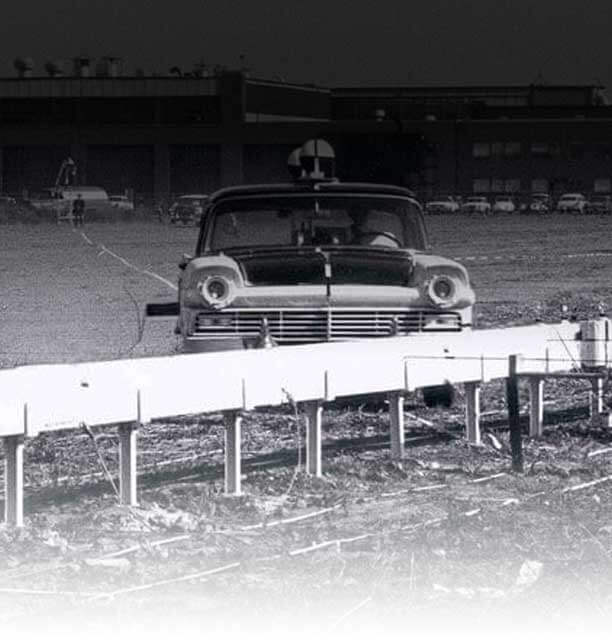
Receives first contract for research on automobile
dynamics
Crash testing leads to development of early
safety features for cars
|
| 1953 |
Designs and develops a C-45 variable stability
aircraft, the first such aircraft with 3-axis
capability, for the U.S. Air Force Wright Aeronautical
Laboratory
|
| 1954 |
Designs retrofit kit for installation of seat
belts in automobiles
|
| 1956 |
Using pioneering ventilated test section technology
developed in 1 foot by 1 foot pilot research
tunnel, upgrades subsonic wind tunnel to transonic
wind tunnel capability
Creates first mobile field unit with Doppler
radar for weather tracking for the U.S. Weather
Bureau
|
| 1957 |
Makes headlines across the nation when it
unveils the Liberty Mutual Safety Vehicle (now
in the Ford Automotive Museum), featuring more
than 60 new safety concepts
|
| 1958 |
Begins testing the Bell Aircraft X-22A variable
stability Vertical Short Take Off and Landing
(VSTOL) research aircraft
Puts first captive trajectory simulation system
into use for weapons integration wind tunnel
testing
|
| 1959 |
Underground ballistics range becomes operational
|
| 1960 |
Accomplishes first accurate airborne simulation
of another aircraft, the NT-33A airborne simulation
of the X-15
Begins variable stability test pilot training
at the U.S. Naval Test Pilot School
Begins operation of a hypersonic shock tunnel
research and test facility
|
| 1961 |
Validates the usefulness of dummies simulating
human behavior in crash tests
|
| 1962 |
Completes radar range and atmospheric simulation
facility
|
| 1963 |
Begins variable stability test pilot training
at the U.S. Air Force Test Pilot School
|
| 1964 |
Develops and flight-tests the first successful
demonstration of ADLAT, an automatic terrain
following radar system
High-power laser laboratory becomes operational
|
| 1965 |
Early development work begins in the area
of aircraft parameter identification
|
| 1966 |
Begins transition from non-profit to for-profit
status as Cornell University undertakes a broad
reexamination of the Laboratory's proper
role in the University's structure
First uses laser beam to successfully measure
gas density
First tests REDCAP, a real-time computer-based
simulator of large-scale electromagnetic warfare
Designs, tests, evaluates and patents box beam
barrier guard rails
|
| 1967 |
Begins developing the Total In-Flight Simulator
(TIFS), a major advance over earlier variable
stability aircraft
Develops and tests a low-speed Omni-directional
Rotating Airspeed Indication System (LORAS)
for helicopters and VSTOL aircraft
U.S. Navy introduces a fully automatic all-weather
carrier landing system developed by CAL
First demonstrates a fingerprint system for
the FBI
Pioneers the first independent HYGE sled test
facility in the world to begin evaluation of
automotive restraint systems
|
| 1968 |
Cornell recommends a separation due to lack
of significant interaction between the
University and the Laboratory
Achieves record wind tunnel testing hours -
7,270 hours equivalent to 303 days of
continuous 24/7 testing
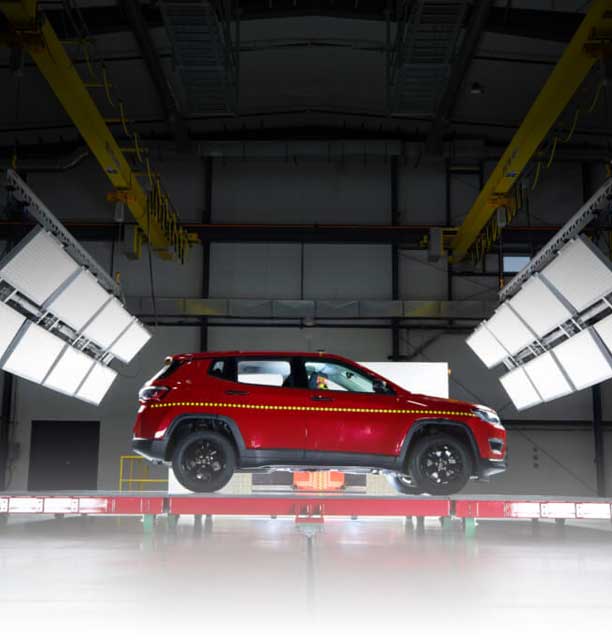
Completes Vehicle Experimental Research Facility
(VERF) for evaluation of vehicle crash
worthiness and vehicle handling characteristics
|
| 1969 |
Performs anti-ballistic missile systems research
Completes flight research hangar and engineering
offices at the Buffalo Niagara
International Airport
Develops the mytron, an instrument for research
on neuromuscular behavior and disorders
|
| 1970 |
First flight of newly developed Total In-Flight
Simulator (TIFS)
|
| 1971 |
New York State Court of Appeals rules unanimously
that Cornell University is allowed to sell
the Laboratory
|
| 1972 |
Cornell's Trustees establish guidelines
which clear the way to create a new for-profit
corporation. Cornell Aeronautical Laboratory
changes its name to Calspan Corporation and
terminates its exemption from federal income
tax.
Cornell University sells 350,000 of 1.1 million
shares of stock in the company to the public
Designs the world's largest flat track
advanced tire research and testing facility
for
commercial and government customers
Completes prototype FBI fingerprint reading
system
|
| 1973 |
Develops MIL-F-8785B, the military specification
for aircraft handling qualities
|
| 1978 |
Arvin Industries acquires the company which
becomes Arvin/Calspan Advanced Technology Center
Initiates charter National Automotive Sampling
Study (NASS)
|
| 1979 |
Produces research safety vehicle that incorporates
advanced safety system concepts
Initiates New Car Assessment Program (NCAP)
crash testing
|
| 1981 |
Maiden voyage of Columbia, the first Space
Shuttle, culminates 10 years of research
including transonic and hypersonic wind tunnel
testing and evaluation of in-flight handling
qualities utilizing TIFS
Performs advanced research and development of
auto airbag systems
|
| 1982 |
Initiates testing of child auto restraint
systems
|
| 1983 |
Partners with the Research Foundation of SUNY
Buffalo to open the Calspan - University of
Buffalo
Research Center (CUBRC), an independent, not-for-profit,
multidisciplinary research center
|
| 1986 |
Completes development work for nation's
"Star Wars" space defense initiative
|
| 1987 |
Acquires Systems Research Laboratories and
company becomes Calspan-SRL
|
| 1988 |
Transonic wind tunnel reaches 100,000 hours
of test operations
Flight research unit receives contract for the
development of a new highly modified Variable-
Stability In-flight Simulator Test Aircraft
(VISTA), F-16D.
|
| 1991 |
Begins performing car-to-car offset testing
with both vehicles in motion
|
| 1993 |
Develops a digital model-following variable
control feel system for the VISTA F 16 and
VAAC Harrier
|
| 1995 |
Arvin Industries completes gradual spin-off
of company to Space Industries International.,
Inc.
|
| 1996 |
Designs and installs automotive test facilities
at Samsung Motors of Korea
|
| 1997 |
Merges with Veda International, Inc. of Alexandria,
Va. and a year later becomes the
Veridian Corporation
Receives major transonic wind tunnel contract
for Joint Strike Force (JSF) testing
(approximately 10,000 hours)
|
| 1998 |
Picabo Street, Olympic skier who trained in
the company's low- speed wind tunnel,
wins a gold medal in the women's super giant
slalom in Nagano, Japan
|
| 1999 |
Develops the only airborne simulation-based
upset recovery training program to help reduce
the leading cause of commercial airline accidents
Next-generation captive trajectory simulation
(CTS) system becomes operational for
transonic wind tunnel weapons integration testing
Designs and supplies first commercial test systems
for advanced pedestrian protection in Europe
|
| 2001 |
Enters 27th consecutive year of performing
crash data collection and analysis for NASS
|
| 2002 |
Performs 2,000th crash test at Vehicle Experimental
Research Facility
|
| 2003 |
Becomes part of General Dynamics, as the Virginia-based
company completes its
acquisition of Veridian. Operates as part of
the Advanced Information Systems (AIS)
division of General Dynamics
Starts work on a new aerospace testing and technology
research complex at the Niagara
Falls, N.Y. International Airport
Performs test number 25,000 at the HYGE sled
test facility
|
| 2004 |
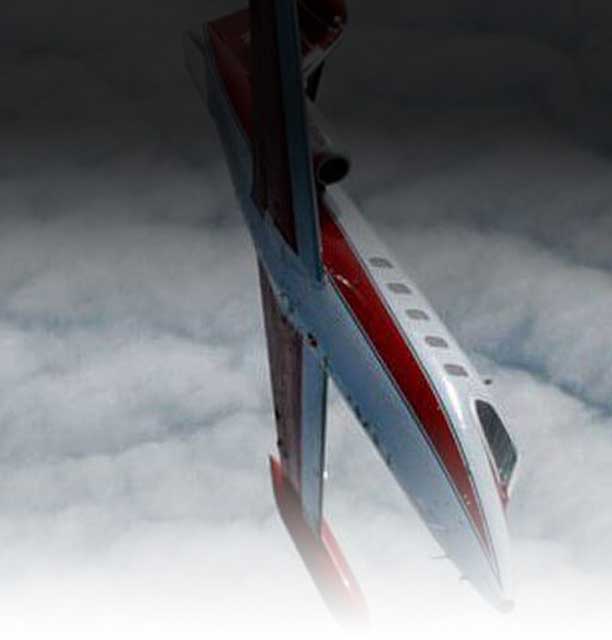
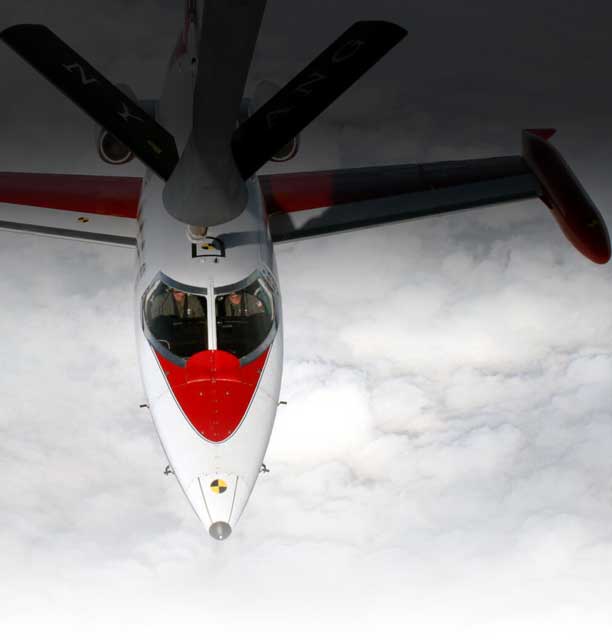
Learjet In-Flight Simulator is used successfully
for a test project to develop automatic aerial
refueling for the U.S. Air Force
Crash Data Resource Center (CDRC) works with
the National Highway Traffic Safety
Administration to develop a national crash causation
survey to collect data on factors that
contribute to motor vehicle accidents
|
| 2005 |
One of Western New York's most-storied
companies - Calspan Corporation -
returns to
local ownership as a local management group
purchases the Aeronautics and Transportation
Testing Groups of the Western New York operation
from General Dynamics
Hosts more than
100 wind tunnel
operators from
throughout the
world - the
largest such
gathering in
history - for
the first joint
conference of
the Supersonic
Tunnel
Association
International (STAI)
and the Subsonic
Aerodynamic
Testing
Association (SATA)
Honored by the
team of Lockheed
Martin, Northrop
Grumman and BAE
Systems for its
contributions to
the development
of the Joint
Strike Fighter (JSF),
a stealthy,
supersonic
multi-role
aircraft
designated the
F-35
Opens a new
$13.3 million
state-of-the-art
flight research
center and
hangar adjacent
to the Niagara
Falls
International
Airport in
Niagara Falls,
N.Y. Complex
serves as
operational
headquarters of
Flight Research
and Systems
Engineering
Groups and
houses fleet of
flight
simulation and
research
aircraft as well
as a full-size
replica of the
X-1, first plane
to break the
sound barrier.
|